الجمعة، 20 ديسمبر 2013

Canada Supreme Court strikes down prostitution laws

Canada Supreme Court strikes down prostitution laws

Terri-Jean Bedford gestures while leaving the Supreme Court of Canada following a hearing on the country's prostitution laws, in Ottawa on 13 June 2013 A constitutional challenge by three women, including dominatrix and former prostitute Terri-Jean Bedford (pictured), prompted the case

Related Stories

The Supreme Court of Canada has unanimously struck down the nation's anti-prostitution laws.
The high court deemed laws prohibiting brothels, communicating in public with clients and living on the profits of prostitution to be too sweeping.
The ruling follows a court challenge filed by former and current sex workers.
The justices' decision gives the Canadian government one year to craft new legislation.
All nine of the court's judges ruled in favour of striking the laws down, finding they were "grossly disproportionate".
Community 'nuisance'
"It is not a crime in Canada to sell sex for money," Chief Justice Beverley McLachlin wrote in Friday's decision.


Canada's criminal code currently makes it illegal to keep a brothel, communicate in public 
about acts of prostitution or live off its proceeds.
But Justice McLachlin wrote: "Parliament has the power to regulate against nuisances, but not at the cost of the health, safety and lives of prostitutes.
"The prohibitions at issue do not merely impose conditions on how prostitutes operate.
"They go a critical step further, by imposing dangerous conditions on prostitution; they prevent people engaged in a risky - but legal - activity from taking steps to protect themselves from the risks."
Under the ruling, the Canadian parliament has 12 months to rewrite the legislation or it will be withdrawn.
Anti-prostitution laws will continue to be enforced in the meantime.
Canadian Justice Minister Peter MacKay said the government would reflect on "this very complex matter".
"We are reviewing the decision and are exploring all possible options to ensure the criminal law continues to address the significant harms that flow from prostitution to communities, those engaged in prostitution and vulnerable persons," his statement said.
A Canadian women's rights group condemned the court's decision, saying it was a "sad day".
"We've now had confirmed that it's OK to buy and sell women and girls in this country," Kim Pate, executive director of the Canadian Association of Elizabeth Fry Societies, told the Canadian Broadcasting Corporation.
"I think generations to come - our daughters, their granddaughters and on - will look back and say, 'What were they thinking?'"
'Compulsion from pimps'
A constitutional challenge by three women with experience in the sex trade, Terri-Jean Bedford, Amy Lebovitch and Valerie Scott, prompted the case.
Valerie Scott (left) leaves the Canadian Supreme Court in Ottawa on 13 June 2013 Valerie Scott (left) was one of the challengers of Canada's prostitution laws
In March, the Ontario Court of Appeal upheld a ban on communicating for the purpose of prostitution, a decision which Ms Bedford challenged.
The federal and Ontario governments appealed against two other parts of that decision: striking down the law against brothels; and limiting the ban on living off the avails of prostitution.
The Canadian authorities argued that they should be entitled to legislate against prostitution as they "see fit".
Lawyers for the Ottawa government reportedly claimed "if the conditions imposed by the law prejudice [sex workers'] security, it is their choice to engage in the activity, not the law, that is the cause".
But the Supreme Court ruled it was not a choice for many.
"Whether because of financial desperation, drug addictions, mental illness, or compulsion from pimps, they often have little choice but to sell their bodies for money," Justice McLachlin wrote.
A demonstrator outside the Supreme Court of Canada in Ottawa on 13 June 2013 A demonstrator outside the Supreme Court of Canada in Ottawa in June

Malky Mackay: Cardiff owner agrees to hold last-minute talks

Vincent Tan (left) and Malky Mackay
20 December 2013 Last updated at 14:46 GMT

Malky Mackay: Cardiff owner agrees to hold last-minute talks

Cardiff owner Vincent Tan instructed chairman Mehmet Dalman to meet him in London on Friday night for talks to decide the future of manager Malky Mackay.
Tan flew to the United Kingdom having told Mackay, 41, to resign or face being dismissed.
Dalman convinced the Malaysian businessman to hold one final round of negotiations.
All I'm here to do is talk about the Liverpool game
Cardiff assistant David Kerslake responds to questions at Friday's news conference
Mackay is now expected to take charge of the team at Liverpool on Saturday.
Earlier in the day, Tan gave Dalman the go-ahead to set about appointing a successor to Mackay and was deciding whether to sack the Scot before or after the weekend's game.
Dalman has a preferred candidate to replace Mackay should he be dismissed - the manager is a high-profile name currently in work outside the UK.
It is understood he would be keen to join Cardiff, but only if given concrete and binding assurances on issues such as Tan's involvement and the job description.
Tan did speak to former Bluebirds boss Dave Jones about a return to the club in some capacity, but he does not intend to follow through with that idea. Jones was replaced by Mackay in June 2011.
Play media
David Kerslake tries to deflect questions about Mackay's future
The owner sent Mackay a letter by email on Monday listing at length his grievances with the 41-year-old and giving him the ultimatum to resign or face being sacked.
Their relationship is understood to be beyond repair, but Mackay has stated he will not resign.
Assistant manager David Kerslake, rather than Mackay, faced the media at a news conference on Friday to look ahead to Saturday's game against Liverpool and refused to discuss Mackay's position.
"All I'm here to do is talk about the Liverpool game," he said

الخميس، 19 ديسمبر 2013

Miami outrun Pacers with last-ditch effort


Miami's Ray Allen hit the go-ahead three-pointer in the final minute as the Heat rallied from a late deficit to beat the Indiana Pacers 97-94 in a clash of NBA divisional leaders.
The Heat-Pacers clash on Wednesday was the highlight of a day when Minnesota made a powerful start which overwhelmed Portland, San Antonio ended Phoenix's winning streak, and father Doc Rivers got the bragging rights over son Austin Rivers as the Los Angeles Clippers defeated New Orleans.
Miami's Dwyane Wade scored 32 points to help the Heat to a victory which moved them within one game of Indiana, which leads the Eastern Conference.
LeBron James set up Allen for the three-pointer that put Miami in front for good with 59.5 seconds left, capping a 10-0 run.
Paul George scored 25 points for the Pacers but missed a three-pointer that would have tied it with four seconds left.
Down by one, the Pacers saw their best chance go awry when George Hill turned the ball over on a bad pass with 14 seconds left.
Allen made two free throws with 10.3 seconds remaining to put Miami up by three, and that capped
a big comeback win for the two-time defending NBA champions.
Love is a winner
Minnesota's Kevin Love had 29 points, 15 rebounds and nine assists, powering the Timberwolves to a 120-109 win over Portland.
Nikola Pekovic had 30 points and nine rebounds for the Timberwolves, who led by 32 in the second quarter and held off a charge in the second half from the Blazers.
Damian Lillard had 36 points, six assists and six rebounds for the weary Trail Blazers, who were completing a four-game road trip.
Meanwhile, San Antonio's Manu Ginobili scored 11 of his 24 points in the final four-plus minutes, steering the Spurs to a 108-101 win over Phoenix.

Tim Duncan added 17 points and 13 rebounds for the Spurs, who were without injured point guard Tony Parker.
Channing Frye scored 15 of his 22 points in the first quarter for the Suns, who had won their previous five games.
They led 95-93 late but Ginobili led San Antonio on a 15-6 scoring run in the closing stages.
Los Angeles' Blake Griffin and DeAndre Jordan each had a double-double as the Clippers beat New Orleans 108-95.
Griffin had 21 points and 10 rebounds before fouling out with 4:05 left, and Jordan added 14 points and 20 boards in the Clippers' third straight victory.
Houston made a big third-quarter run which set up a 109-94 win over Chicago.
Dallas' Dirk Nowitzki scored 20 points in his return to the lineup after a stomach virus, helping the Mavericks beat undermanned Memphis 105-88.
Detroit's Brandon Jennings led Detroit to a 107-106 win over Boston, scoring 28 points and matching his season high with 14 assists.
Korver flying high
Atlanta's Kyle Korver made seven consecutive three-point attempts on his way to a season-high 28 points, pushing the Hawks to a 124-107 victory over Sacramento.
Charlotte's Kemba Walker hit a buzzer-beating jumper in overtime, giving the Bobcats a 104-102 win over Toronto.
Washington's John Wall scored 21 points and made two big defensive plays against in the closing moments to lead the Wizards to a 113-107 victory over Brooklyn.
Utah's Trey Burke had a career-high 30 points and eight assists, leading the Jazz to an 86-82 win at Orlando.
New York's Tyson Chandler returned from his broken leg to help the Knicks beat Milwaukee 107-101 in double overtime.

Miami outrun Pacers with last-ditch effort

Hein Verbruggen, the former head of world cycling, has rejected a claim from Lance Armstrong that he helped cover up a positive drug test for the disgraced American cyclist.
Last month, Armstrong claimed that in 1999, the year he won the first of his seven Tour de France titles, Verbruggen encouraged him to stay quiet over a positive test for a banned steroid.
Play media
Lance Armstrong admits doping to win cycling titles
When asked if he colluded with Armstrong, Dutchman Verbruggen said: "It is not true. Lance is mixing up two things, purposefully perhaps."
Armstrong was stripped of his Tour de France titles last year, before admitting he had taken performance-enhancing drugs during his career.
Verbruggen, 72, was president of the International Cycling Union (UCI) when Armstrong tested positive at the 1999 Tour de France.
Armstrong claims Verbruggen agreed to blame a backdated prescription for a steroid cream to treat saddle sores to help protect the image of the sport.
However Verbruggen, still a member of the International Olympic Committee (IOC), told BBC Sport's Matt Slater: "He is mixing up an adverse analytical finding and we have about 3,000 adverse analytical findings per year from all sports.
Play media
"Of these 3,000, there are about 800 which remain and which are to be considered by the governing bodies as positive.
"He was never positive because at that time it was an adverse analytical finding. The laboratory found some cortisones in his sample. That was treated by the French ministry and the French ministry considered that it could not be a doping case because they saw he was not having it every day in his urine, it had to come from an ointment.
"The French then decided this was not a positive case."

Armstrong cover-up claim denied by Hein Verbruggen

Hein Verbruggen, the former head of world cycling, has rejected a claim from Lance Armstrong that he helped cover up a positive drug test for the disgraced American cyclist.
Last month, Armstrong claimed that in 1999, the year he won the first of his seven Tour de France titles, Verbruggen encouraged him to stay quiet over a positive test for a banned steroid.

Lance Armstrong admits doping to win cycling titles
When asked if he colluded with Armstrong, Dutchman Verbruggen said: "It is not true. Lance is mixing up two things, purposefully perhaps."
Armstrong was stripped of his Tour de France titles last year, before admitting he had taken performance-enhancing drugs during his career.
Verbruggen, 72, was president of the International Cycling Union (UCI) when Armstrong tested positive at the 1999 Tour de France.
Armstrong claims Verbruggen agreed to blame a backdated prescription for a steroid cream to treat saddle sores to help protect the image of the sport.
However Verbruggen, still a member of the International Olympic Committee (IOC), told BBC Sport's Matt Slater: "He is mixing up an adverse analytical finding and we have about 3,000 adverse analytical findings per year from all sports.
Play media
"Of these 3,000, there are about 800 which remain and which are to be considered by the governing bodies as positive.
"He was never positive because at that time it was an adverse analytical finding. The laboratory found some cortisones in his sample. That was treated by the French ministry and the French ministry considered that it could not be a doping case because they saw he was not having it every day in his urine, it had to come from an ointment.
"The French then decided this was not a positive case."

الأربعاء، 18 ديسمبر 2013

Hearing-impaired NFL player makes no excuses

As people hear about me being hard of hearing and making the best of it, the biggest thing that I want others to know is that excuses get you nowhere.
I know I've made some, but I was fortunate enough to have people in my corner who wouldn't let me use them. Whatever your dream is -- go for it. Any reason for you not getting it is just an excuse.
Life is hard as it is, but when you have it in your mind that no matter what your dream is, you will try your hardest to achieve it. Your life will be more enjoyable, and it will make the struggle worth it.
Ever since I can remember, I always played sports. Most people would say I wouldn't succeed, but I proved them wrong by finding ways to make it work -- by finding ways that helped me hear and put me in a position to succeed.
Was it easy? No, but it was worth it.
If you ask me what I'm most proud of, it's not just playing football in the NFL; it's graduating from Troy High School and from UCLA with a political science degree. I could have easily made excuses as to why I couldn't do my work and blamed it on not being able to hear well, but I didn't.
Some people ask me, do I wish that I had normal hearing like everyone else, and honestly looking back at my life now, I would say no.
Being hearing-impaired/deaf has made me who I am. The struggle, pain, tears, happiness and joy has put me in the position where I am today.
Don't let adversity define who you are. Let how you respond to diversity be who you are.
Find a way.
No excuses.
It will be worth it. It was for me.

Crazy world of minigolf: Waterfalls, wooden heads, a 50-foot volcano

It's the putt all golfers want to be stood over. The final hole of a Masters weekend, find the cup and the coveted green jacket is yours.
Your heart is racing, your palms sweaty, can you maintain your focus?
The contender surveys the scene, taking in the erupting volcano and giant wooden heads which line the Hawaiian Rumble course before delicately guiding her shot off a brick and into the hole.
No, not the Augusta National Country Club, but a minigolf course in Myrtle Beach.
Not Tiger Woods, but 18-year-old Olivia Prokopova, one of the world's leading minigolf players and a double Masters champion.
"I started playing as a three-year-old kid," the Czech told CNN.
 

"My dad worked as a sports reporter and he took me with him to an interview he did with a minigolf trainer. I tried to play there and really liked it. Apparently, I kept asking when we would go back to play more.
"Since then, I played regularly, and started going to tournaments."
Minigolf, commonly referred to as crazy golf, originated in 1867 at the Royal and Ancient Golf Club in St. Andrews, Scotland.
With women at the time keen to play the conventional game, and the violent swinging action required to hit a drive deemed most unladylike, an 18-hole course of putting greens was built.
The rest, as they say, is history and 150 years later people from all over the world enjoy minigolf in a wide variety of locations on courses littered with tiny waterfalls and animatronic dinosaurs.
It might not be as famous or well-known as the full-size game -- "big golf," as Prokopova says -- but away from the fairways and bunkers of conventional courses is a hardcore community of players dedicated to golf's miniature cousin.
And none are more dedicated than Bob Detwiler, the founder of the U.S. Pro Minigolf Federation.
Detwiler opened the Hawaiian Rumble course in 1992 and decided to start holding tournaments. The first was the Masters in 1997, followed one year later by the U.S. Open.
While the former is always held at Detwiler's course, the latter annually switches location, mirroring the long-established traditions of golf's equivalent tournaments.
And the similarities have not been lost on those at Augusta National Golf Club, home since 1934 of what is now the season's opening major tournament.
"I've been called three of four times by the people at Augusta," explained Detwiler. "They said I was infringing on their name and stuff.
God's golfers: Faith on tour
How to putt like Martin Kaymer
Charley Hull's incredible journey
"I said, 'How can that be? There's the Masters of tennis, of marbles. You name it, there's a Masters of it.'
"They asked me to do certain things, but they've never said I need to cease and desist."
The Hawaiian Rumble course -- "our Augusta," boasts Detwiler -- annually attracts players from across the globe for the Masters, a tournament Prokopova has won in each of the last two years.
While Adam Scott took home $1.44 million for his Green Jacket success in April, minigolf's event has a total prize fund of just $12,000.
"The season is expensive," admits Prokopova. "Traveling to the U.S. is expensive. We usually go there three weeks to a month before a tournament.
"All prize money goes back into the travels, but I still need sponsors and my parents contribute to these trips."
Prokopova's commitment to the sport is unquestionable. Not only does she fly 4,500 miles to compete in the U.S., she is joined by an entourage including both of her parents, her coach and, if you believe Detwiler, even a masseuse.
"I was seven when I first traveled to the U.S. for a tournament," said Prokopova.
"The atmosphere was absolutely amazing. All the other players would stand around me and cheer, some of them screaming and jumping in the air."
Prokopova's fellow competitors tend to be middle-aged men who enjoy the heat of competition and the fraternity which comes with being an obscure sportsman.
However Detwiler admits that some find losing to a teenage girl difficult to take.
"They've known her since she was seven years old, so they all like her," said Detwiler.
"But at the same time they want to win too. And they don't like it when some girl beats them!"
But the response to Propokova is almost entirely positive, with America's minigolf courses a home away from home for the prodigy.
A new generation of golfing stars emerge
Golf: The success stories of 2013
"When at a tournament, it really feels like we are one big family," said Prokopova. "We see each other regularly, at least twice a year, and we know each other. The players' community is very supportive, I don't feel much rivalry.
"I have once beaten the same player in sudden-death playoffs three times in row. He was a little upset and walked away briskly, but even then, he later came back and offered his congratulations.
"And that was the only time I could feel any sort of over-competitiveness."
As minigolf continues to grow, the sport's family could welcome more and more foreign members, with players from far and wide flocking to tournaments across the globe.
"The World Minigolf Federation is seeing a rise in player numbers, clubs and events and greater recognition of Minigolf as a sport," its sport director Pasi Aho told CNN.
"There are now 46 member nations in the World Minigolf Sport Federation, with South Korea and Mongolia our most recent members.
"With over 1,300 tournaments played each year, including World, European and Asian Championships, there are now 38,000 registered players competing in a wide range of tournaments."
For Prokopova, more major titles surely lie in wait. After all, she has won two green jackets before her 19th birthday, two more than 14-time major winner Woods had at that age.
And Prokopova has set her sights on a showdown with "big golf's" biggest star.
"We have challenged Tiger Woods on several occasions, mainly through the media, but he never responded. Maybe he is afraid?!" she joked.
Over to you, Tiger...

Raja Casablanca deny Ronaldinho at FIFA Club World Cup

They are the little known Moroccan champions who have decimated the dream of Brazilian great Ronaldinho.
Raja Casablanca, playing in FIFA's Club World Cup by virtue of Morocco being hosts, will now face European Champions Bayern Munich on Saturday in a bid to be crowned the globe's finest club team.
They beat Brazil's Atletico Mineiro 3-1 in Marrakech to become only the second African side to make the showpiece final, and in the process deny Ronaldinho perhaps his last shot at landing the prestigious crown.
The 33-year-old has a host of titles to his name, including the 2002 World Cup with Brazil, and spoke of his desire to break into their squad before his home country host the next installment, in 2014.
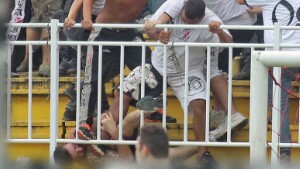
Fighting erupts in football stands
Brazil's World Cup venues
Pele's dream World Cup matches
But though he got on the scoresheet with a brilliant, trademark free kick to level the game at 1-1, his side couldn't hold out and conceded two late goals.
Ronaldinho was a losing finalist with Barcelona in 2006 and will now have to make do with a match against Asian champions Guangzhou Evergrande to determine who finishes third in the tournament that pits the champions of each continent against each other.
The former PSG and Flamengo star is rumored to be leaving Mineiro when his contract runs out and could be a target for Turkish club Besiktas.
When his curling free kick cannoned off the post and into the net just after the hour mark to make it 1-1, Ronaldinho could be forgiven for dreaming of adding the Club World Cup to his maiden Copa Libertadores triumph with Mineiro.
It canceled out Raja Casablanca's opener, scored when Mouhssine Iajour drilled a low shot into the bottom corner from outside the penalty area.
Despite a flurry of pressure after they scored Mineiro then shot themselves in the foot as Rever brought down Iajour inside the area, Mohsine Moutouali converting from the spot.
As Mineiro pressed hard for a second equalizer, Vianney Madibe made the game safe to spark wild scenes of celebration in Marrakech in front of 35,000 fans.
After spoiling Ronaldinho's night Raja will aim to do the same to Bayern on Saturday, as the Germans go for their fifth trophy of a remarkable year.

الثلاثاء، 17 ديسمبر 2013

Epic Soccer Training - Improve Soccer Skills

More Than 40,000 Players Worldwide Are Already Using This "Strange" Dribbling System To Quickly Develop "Pro Handles" And Ball-On-A-String Confidence Like Never Before..

Pro Guard Trainer Alex Maroko GIVES AWAY His Best 4-Week Dribbling Workout -- 100% FREE!

Hey and welcome to the best site on the web for getting unstoppable handles.
After entering your BEST email address in the form to the right, I’m going to GIVE YOU my best 4-week stationary dribbling program, The Basement Ball-Handling Chronicles.
By using this 12-minute dribbling workout, you’ll find
your handles on the court improving faster than ever before.
One rule before you begin..

You MUST be a serious basketball player.
My programs do not work for lazy players with little determination.
If that’s not you, then let’s jump right in.
I’ll see you on the other side with your free 4-Week Ball-Handling Workout that your determination just earned you.
Yours in unstoppable handles,
-Coach Alex
Click

Epic Soccer Training - Improve Soccer Skills

Epic Soccer Training - Improve Soccer Skills

Let This All-American, Former Pro Soccer Player Show YOU Exactly How To Drastically Improve Your Touch, Shooting, Dribbling, Moves, And Gain Masterful Soccer Skills

How would you like to join the THOUSANDS of other soccer players around the world who are now striking the ball with more power, faking out defenders with ease, dribbling with great precision … and playing with more amazing soccer skills than they ever thought possible?

“You have made a huge difference in my game…”

“You have literally made a difference for me this year by watching your videos all summer. I have new tricks that I have learned from you, and its great to have a guy like you who I can get tips from. All I have to say is thanks so much man. You have made a huge difference in my game that even the other players are noticing!”

~ Andre

As a highly skilled All-American, Former Professional level soccer player from Orlando, Florida, Matt has worked with soccer players of all levels – from other professional level and All-American players…to total beginners of all ages that are just learning the game.
Why do so many people come to Matt for help…and why do his students absolutely rave about him and his methods?
It’s because he get the results they’re looking for!
And what he has done for THEIR soccer skills, he can now do for YOU.
…because in an effort to reach out and help even more of those aspiring soccer players who could benefit most from his training method, Matt introduces you to…
…a breakthrough soccer training program that has helped thousands of players all across the world take their soccer skills to new heights…
Now let’s hear what Matt himself has to say about this popular training program that’s already been snapped up by more than 10,000 soccer players worldwide:
Hi, I’m Matt Smith…
And I’d like to tell you a little of the story behind this new soccer training program, so you can clearly see what sets it apart from the rest…
…and why most of my students go so quickly from struggling, frustrated, not the player they want to be … to becoming confident, consistent, excited, and highly skilled soccer players.

“I was able to make the VARSITY team this year…”

“Hey Matt, I got the Epic Soccer Training program in the beginning of the summer and it really helped my game.  Last year I got cut from my high school jv team. But with the help of the program I was able to make the VARSITY team this year.  Thanks alot for your help.”

~ Matt Rostek

You see, I wasn’t always the best soccer player, I rode the bench for years even though I was on my school team, club teams, and went to practice all the time.
So I understand every frustration of not being the player you want to be, not getting the playing time you want, and not having the skills you need to be a great player.
But, I was able to overcome all of this and literally transform my soccer playing ability…

Who Am I and Why Should You Listen to Me?

Here is a little about me as a soccer player:
  • 3 time all-state soccer player in the state of Florida
  • Florida soccer player of the year
  • High school All-American
  • Collegiate All-American
  • Former Professional Soccer player
More importantly I used to be just like you.  My dream was to become a professional soccer player and be the best player on the field but I didn’t know how to actually improve my soccer skills and I was always just an average soccer player.
I went to practices all the time, joined a club team, and played year round and practiced as hard as I could.
But I never got any better than the other players on my team.
Eventually I realized that there must be a way that these great soccer players were improving their soccer skills that I wasn’t being taught by my soccer coaches.  I started studying, researching, and talking to some of the best players and coaches in the country.

I trained with some of the best and
studied everything I could about soccer…

I spent time training with some of the best coaches in the world and my high school coach went on to be named the #1 coach in the USA in any sport.
My experience studying with top level coaches and trainers made me realize what I had always been missing in soccer practice.  I learned why, no matter how many soccer practices I went to, I wasn’t getting better than anyone else.
I worked just as hard, if not harder, than anyone else in practice but I still remained an average soccer player.  And because I was a small player the coach would rarely put me in because he was afraid I’d get hurt.
One day, my eyes were opened when I saw how professional players trained and began understanding how to truly become a highly skilled, game-changing player.
I then spent thousands of hours developing my skills and always searching for new training methods that would take my playing to the top.
And it worked when I was recruited to play professional soccer before I was even out of college.

Here’s where YOU come in…

In 2003, my college team asked me to hold a special training camp so that I could teach them the skills and training methods that I was using.  Many of them didn’t have the skills, control, touch, power, and moves that they wanted…
And of course they wanted to be great players and saw how I was able to take over games when I needed to…
What these players needed was a different approach to soccer training…one that wasn’t being taught in traditional soccer practices but that would help to skyrocket their individual skills quickly.

How is this training different?

The soccer training methods I was teaching actually helped several other players reach All-American status and a couple others received honorable mentions.  And it was all after they had gone through my training program.
The thing I realized about training after watching the pros and working with high level coaches was that traditional soccer practices were NOT the correct way to become a great player.
Traditional soccer practices are meant for “team building” much more than developing your own skills.
So I developed a training method designed specifically for skyrocketing a player’s individual skills.  Here’s what I did:
  • First, I created training sessions that simulated game speed and conditions so that the skills you practice are easy to apply when it is game time.
  • Next, I developed highly effective drills that are specifically designed to quickly improve individual soccer skills such as ball control, touch, dribbling skills, passing skills, shooting power and precision, and even soccer I.Q.
  • And finally, I made sure that every player that went through my program would be the most skilled player on the field…every time…by teaching a plethora of advanced soccer moves that are guaranteed to keep the defender guessing and on their heels.

It’s all about “Dynamic Touches”

Here’s a quick question for you:  What was the soccer skill that Wayne Rooney said was THE most important part of being a great player?
Answer: He said, “touch”, was the key aspect of being a great player and even more specifically your “first touch”.
The Epic Soccer Training system actually uses drills and exercises that are designed to drastically improve your touch.  And while a lot of soccer drills teach you slow movements, I found that “dynamic touches” where you are moving at a fast pace is much more effective in developing your skills.
You can actually get thousands of more effective touches in just a fraction of the time with this training program.
So you get better…faster 


Click

الأحد، 15 ديسمبر 2013

Golf

Golf

Golf
Golfer swing.jpg
A golfer in the finishing position after taking a "tee shot"
Highest governing body R&A
USGA
International Golf Federation
First played 15th century, Scotland
Characteristics
Contact No
Categorization Outdoor
Equipment Golf clubs, golf ball
Olympic 1900, 1904, 2016,[1] 2020[2]
Golf is a precision club and ball sport in which competing players (or golfers) use many types of clubs to hit balls into a series of holes on a course using the fewest number of strokes. Golf is defined, in the rules of golf, as "playing a ball with a club from the teeing ground into the hole by a stroke or successive strokes in accordance with the Rules."
It is one of the few ball games that do not require a standardized playing area. Instead, the game is played on a golf course, in general consisting of an arranged progression of either 9 or 18 "holes." Each hole on the course must contain a "tee box" to start from, and a "putting green" containing the actual hole. There are various other standardized forms of terrain in between, such as the fairway, rough, and hazards, but each hole on a course, and indeed among virtually all courses, is unique in its specific layout and arrangement.
Golf competition is generally played for the lowest number of strokes by an individual, known simply as stroke play, or the lowest score on the most individual holes during a complete round by an individual or team, known as match play. Stroke play is the most commonly seen format at virtually all levels of play, although variations of match play, such as "skins" games, are also seen in televised events. Other forms of scoring also exist.


Tennis

Tennis     


Tennis
Centre Court.jpg
A tennis match at Wimbledon, the oldest and the most prestigious tennis tournament.
Highest governing body International Tennis Federation
First played Between 1859 and 1865 (Birmingham, England)
Characteristics
Contact No
Team members Single or doubles
Mixed gender Yes, separate tours & mixed doubles
Categorization Racquet sport
Equipment Tennis ball, tennis racquet
Venue Indoor or outdoor tennis court
Olympic Part of Summer Olympic programme from 1896 to 1924
Demonstration sport in the 1968 and 1984 Summer Olympics
Part of Summer Olympic programme since 1988
Paralympic Part of Summer Paralympic programme since 1992
Country or region Worldwide
Tennis is a sport that people usually play individually against a single opponent (singles) or between two teams of two players each (doubles). Each player uses a racquet that is strung with cord to strike a hollow rubber ball covered with felt over or around a net and into the opponent's court. The object of the game is to play the ball in such a way that the opponent is not able to play a good return.
Tennis is an Olympic sport and is played at all levels of society and at all ages. The sport can be played by anyone who can hold a racquet, including wheelchair users. The modern game of tennis originated in Birmingham, England, in the late 19th century as "lawn tennis".[1] It had close connections both to various field ("lawn") games such as croquet and bowls as well as to the older raquet sport of real tennis. During most of the 19th-century in fact, the term "tennis" referred to real tennis, not lawn tennis: for example, in Disraeli's novel Sybil (1845), Lord Eugene De Vere announces that he will "go down to Hampton Court and play tennis."[2]
The rules of tennis have changed little since the 1890s. Two exceptions are that from 1908 to 1961 the server had to keep one foot on the ground at all times, and the adoption of the tie-break in the 1970s. A recent addition to professional tennis has been the adoption of electronic review technology coupled with a point challenge system, which allows a player to contest the line call of a point.
Tennis is played by millions of recreational players and is also a popular worldwide spectator sport. The four Grand Slam tournaments (also referred to as the "Majors") are especially popular: the Australian Open played on hard courts, the French Open played on red clay courts, Wimbledon played on grass courts, and the US Open played also on hard courts.


Rules of basketball

Rules of basketball

        The rules of basketball are the rules and regulations that govern the play, officiating, equipment and procedures of basketball. While many of the basic rules are uniform throughout the world, variations do exist. Most leagues or governing bodies in North America, the most important of which are the National Basketball Association and NCAA, formulate their own rules. In addition, the Technical Commission of the International Basketball Federation (FIBA) determines rules for international play; most leagues outside North America use the complete FIBA ruleset.  


Original rules

In 1891 James Naismith published his rules for the game of "Basket Ball" that he invented:[1] The original game played under these rules was quite different than the one played today as there was no dribbling, dunking, three-pointers, or shot clock, and goal tending was legal.
  1. The ball may be thrown in any direction with one or both hands.
  2. The ball may be batted in any direction with one or both hands.
  3. A player cannot run with the ball. The player must throw it from the spot on which he catches it, allowance to be made for a man who catches the ball when running at a good speed if he tries to stop.
  4. The ball must be held in or between the hands; the arms or body must not be used for holding it.
  5. No shouldering, holding, striking, pushing, or tripping in any way of an opponent. The first infringement of this rule by any person shall count as a foul; the second shall disqualify him until the next basket is made or, if there was evident intent to injure the person, for the whole of the game. No substitution shall be allowed.
  6. A foul is striking at the ball with the fist, violation of rules three and four and such described in rule five.
  7. If either side makes three consecutive fouls, it shall count a goal for the opponents (consecutive means without the opponents in the mean time making a foul).
  8. A goal shall be made when the ball is thrown or batted from the grounds into the basket and stays there (without falling), providing those defending the goal do not touch or disturb the goal. If the ball rests on the edges, and the opponent moves the basket, it shall count as a goal.
  9. When the ball goes out of bounds, it shall be thrown into the field of play and played by the first person touching it. In case of dispute the umpire shall throw it straight into the field. The thrower-in is allowed five seconds. If he holds it longer, it shall go to the opponent. If any side persists in delaying the game, the umpire shall call a foul on that side.
  10. The umpire shall be the judge of the men and shall note the fouls and notify the referee when three consecutive fouls have been made. He shall have power to disqualify people according to Rule 5.
  11. The referee shall be judge of the ball and shall decide when the ball is in play, in bounds, to which side it belongs, and shall keep the time. He shall decide when a goal has been made and keep account of the baskets, with any other duties that are usually performed by a scorekeeper.
  12. The time shall be two fifteen-minute halves, with five minutes rest between.
  13. The side making the most points in that time is declared the winner.

Players, substitutes, teams and teammates

Naismith's original rules did not specify how many players were to be on the court. In 1900, five players became standard, and players that were substituted were not allowed to re-enter the game.[citation needed] Players were allowed to re-enter a game once from 1921, and twice from 1934; such restrictions on substitutions were abolished in 1945 when substitutions became unlimited. Coaching was originally prohibited during the game, but from 1949, coaches were allowed to address players during a time-out.
Originally a player was disqualified on his second foul. This limit became four fouls in 1911 and five fouls in 1945, still the case in most forms of basketball where the normal length of the game (before any overtime periods) is 40 minutes. When the normal length is 48 minutes (this is the case with the National Basketball Association in the United States) a player is accordingly disqualified on his sixth foul.

Shot clock and time limits

The first time restriction on possession of the ball was introduced in 1933, where teams were required to advance the ball over the center line within ten seconds of gaining possession. This rule remained until 2000, when FIBA reduced the requirement to eight seconds, the NBA following suit in 2001. The NCAA retains the 10-second rule for men's play, but has yet to adopt this rule for women's play. In May 2013, the NCAA women's basketball rules committee recommended adding the 10-second rule starting in the 2013–14 season; the change is expected to be approved by an NCAA oversight committee in June.[2] U.S. high schools, whose rules are drafted by NFHS, also use the 10-second rule for both sexes.
In 1936 the three-second rule was introduced. This rule prohibits offensive players from remaining near their opponents' basket for longer than three seconds (the precise restricted area is also known as the lane or the key). A game central to this rule's introduction was that between the University of Kentucky and New York University. Kentucky coach Adolph Rupp did not take one of his referees with him, despite being warned of discrepancies in officiating between the midwest and east by Notre Dame coach George Keogan, and the game became especially rough. Because of this game and others, 6'5" (1.96 m) Kentucky All-American center Leroy Edwards is generally recognized as the player responsible for the 3 second rule.
While the rule was originally adopted to reduce roughness in the area between big men, it is now considered to prevent tall offensive players from gaining an advantage by waiting close to the basket. When the NBA started to allow zone defense in 2001, a three-second rule for defensive players was also introduced.
The shot clock was first introduced by the NBA in 1954, to increase the speed of play. Teams were then required to attempt a shot within 24 seconds of gaining possession, and the shot clock would be reset when the ball touched the basket's rim or the backboard, or the opponents gained possession. FIBA adopted a 30-second shot clock two years later, resetting the clock when a shot was attempted. Women's basketball adopted a 30-second clock in 1971. The NCAA adopted a 45-second shot clock for men while continuing with the 30-second clock for women in 1985. The men's shot clock was then reduced to 35 seconds in 1993. FIBA reduced the shot clock to 24 seconds in 2000, and changed the clock's resetting to when the ball touched the rim of the basket. Originally, a missed shot where the shot clock expired while the ball is in the air constituted a violation. In 2003 the rule was changed so that the ball remains live in this situation, as long as it touched the rim. If the ball touches the rim and slightly bounces over the basketball hoop it will be called as a loose ball.

Fouls, free throws and violations

Dribbling was not part of the original game, but was introduced in 1901. At the time, a player could only bounce the ball once, and could not shoot after he had dribbled. The definition of dribbling became the "continuous passage of the ball" in 1909, allowing more than one bounce, and a player who had dribbled was then allowed to shoot.
Running with the ball ceased to be considered a foul in 1922, and became a violation, meaning that the only penalty was loss of possession. Striking the ball with the fist has also become a violation. From 1931, if a closely guarded player withheld the ball from play for five seconds, play was stopped and resumed with a jump ball; such a situation has since become a violation by the ball-carrier. Goaltending became a violation in 1944, and offensive goaltending in 1958.
Free throws were introduced shortly after basketball was invented. In 1895, the free throw line was officially placed fifteen feet (4.6 m) from the backboard, prior to which most gymnasiums placed one twenty feet (6.1 m) from the backboard. From 1924, players that received a foul were required to shoot their own free throws. One free throw shot is awarded to a player who was fouled while making a successful field goal attempt. If the field goal attempt is unsuccessful, two free throw shots are awarded (three if the player was attempting a three-point field goal). If an offensive player is fouled while not in the act of shooting, or if a player is fouled in a loose-ball situation, the penalty varies by level of play and the number of fouls accumulated by the opposing team in a given period.
  • In NCAA and NFHS play:
    • If the player's team has 6 or fewer team fouls in the half, the team fouled gets possession of the ball.
    • If the team has 7 to 9 team fouls, the player fouled goes to the line for what is called "one-and-one" or the "bonus"—that is, if the player makes the first free throw, he gets the opportunity to attempt a second, but if he misses, the ball is live.
    • If the team has 10 or more fouls in the half, the player fouled gets two free throws, often called the "double bonus".
    • All overtime periods are considered an extension of the second half for purposes of accumulated fouls. Also, NFHS rules accumulate fouls per half, even though games are played in quarters.
  • In the NBA:
    • If the player's team has 4 or fewer team fouls in the quarter, the team fouled gets possession of the ball.
    • Starting with the team's fifth foul in the quarter, the player fouled gets two free throws.
    • Overtime is not considered an extension of any quarter. Instead, the "penalty" of two free throws is triggered on the team's fourth foul in that overtime period (instead of the fifth).
    • Foul limits are reset in the last two minutes of a quarter or overtime period. If a team has not reached its limit of accumulated fouls, the first team foul in the last two minutes results in possession by the team fouled, and all subsequent fouls result in two free throws.
  • In FIBA play:
    • If the player's team has 4 or fewer team fouls in the quarter, the team fouled gets possession of the ball.
    • Starting with the team's fifth foul in the quarter, the player fouled gets two free throws.
    • During an interval of play, all team members entitled to play are considered as players.
    • The ball become dead when an official blows his whistle while the ball is live
    • All overtime periods are considered an extension of the fourth quarter for purposes of accumulated fouls.
A player has 10 seconds to attempt a free throw. If the player does not attempt a free throw within 10 seconds of receiving the ball, the free throw attempt is lost, and a free throw violation is called. A free throw violation also occurs if a free throw misses the backboard, rim, and basket. If a free throw violation is assessed in the last free throw awarded to a player in a given situation, possession automatically reverts to the opposing team.
A charge is physical contact between an offensive player and a defensive player. In order to draw an offensive charge the defensive player must establish legal guarding positioning in the path of the offensive player. If contact is made, the officials would issue an offensive charge. No points will be allowed and the ball is turned over. The defensive player may not draw an offensive charge in the "restricted zone" (see below for more details).[3]
Blocking is physical contact between the offensive player and the defensive player. Blocking fouls are issued when a defensive player interferes with the path of the offensive player in the shooting motion. Blocking fouls are easily called when the defensive player is standing in the "restricted zone".[3]
Restricted zone: In 1997, the NBA introduced an arc of a 4-foot (1.22 m) radius around the basket, in which an offensive foul for charging could not be assessed. This was to prevent defensive players from attempting to draw an offensive foul on their opponents by standing underneath the basket. FIBA adopted this arc with a 1.25 m (4 ft 1.2 in) radius in 2010.[4]

Equipment

The ball was to be an "ordinary Association football". In other words, a soccer ball.[5] The goal is placed 10 feet (3.05m) above the court. Originally a basket was used (thus "basket-ball"), so the ball had to be retrieved after each made shot. Today a hoop with an open-bottom hanging net is used instead.

Officiating and procedures

Originally, there was one umpire to judge fouls and one referee to judge the ball; the tradition of calling one official the "referee" and the other one or two the "umpires" has remained (the NBA, however, uses different terminology, referring to the lead official as "crew chief" and the others as "referees"). Today, both classes of officials have equal rights to control all aspects of the game. The NBA added a third official in 1988, and FIBA did so afterward, using it for the first time in international competition in 2006. The use of video evidence to inform referee's decisions has always been banned, except in the case of determining whether or not the last shot of a period was attempted before time expired. This exception was introduced by the NBA in 2002 and adopted by FIBA in 2006. The NCAA, however, has permitted instant replay for timing, the value of a field goal (two or three points), shot clock violations, and for purposes of disqualifying players because of unsportsmanlike conduct. The NBA changed its rules starting in 2007 to allow officials the ability to view instant replay with plays involving flagrant fouls, similar to the NCAA. In Italy's Serie A, an American football-style coach's challenge is permitted to challenge (at the next dead ball) an official's call on any situation similar to the NCAA.
The center jump ball that was used to restart a game after every successful field goal was eliminated in 1938, in favor of the ball being given to the non-scoring team from behind the end line where the goal was scored, in order to make play more continuous. The jump ball was still used to start the game and every period, and to restart the game after a held ball. However, the NBA stopped using the jump ball to start the second through fourth quarters in 1975, instead using a quarter-possession system where the loser of the jump ball takes the ball from the other end to start the second and third periods, while the winner of that jump ball takes the ball to start the fourth period from the other end of the court.
In 1981, the NCAA adopted the alternating possession system for all jump ball situations except the beginning of the game, and in 2003, FIBA adopted a similar rule, except for the start of the third period and overtime. In 2004, the rule was changed in FIBA that the arrow applies for all situations after the opening tap.
In 1976, the NBA introduced a rule to allow teams to advance the ball to the center line following any legal time-out in the final two minutes of the game. FIBA followed suit in 2006.

International Rules of Basketball

The most recent international rules of basketball were approved April 26, 2008 by FIBA and became effective October 1 of that year.[6]
There are eight rules encompassing 50 articles, covering equipment and facilities, regulations regarding teams, players, captains and coaches, playing regulations, violations, fouls and their penalties, special situations, and the officials and table officials. The rules also cover officials' signals, the scoresheet, protest procedure, classification of teams and television timeouts.

Football: Rules

Football: Rules

The rules of football can be complex and vary depending on the level of play. We will cover some of the basics here including the field, players, offense, defense, and penalties.
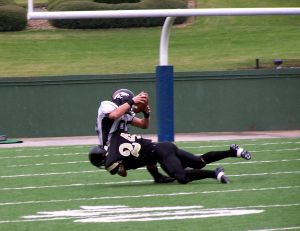
Football Catch
Football Field

The football field is 120 yards long and 53 ½ yards wide. At each end of the field and 100 yards apart are the goal lines. The additional 10 yards at each end is the end zone. The field is divided up every 5 yards by a yard line. The middle yard line marker is called the 50 yard line. In parallel to the side lines are rows of hash marks. The football is always placed on or between the hash marks at the start of each play. This ensures that the teams have space to line up on both sides of the football. The position of the football that defines the sides of the ball is called the "line of scrimmage".

There are also goal posts at the back of each football end zone. One way to score is to kick the football through the goal posts. The ball must go between the uprights and over the crossbar.

If any part of a player with the football touches outside the side lines or the end zone it is considered Out of Bounds.

Game Format

Football is a timed sport. The team with the most points at the end of the time period, wins the game. The game is divided up into 4 periods or quarters with a long "half time" between the second and third quarter. Time is counted while plays are running and sometimes between plays (i.e. time continues after a running play where the player was tackled in bounds, but stops on an incomplete pass). To keep the game going at a good pace the offense has a limited time (called the play clock) between plays.

Football Players

The rules in football allow each team to have eleven players on the field at a time. Teams may substitute players between plays with no restrictions. Each team must start a play on their side of the ball.

The defensive players may take any position they want and can move about their side of the football prior to the play without restriction. Although there are certain defensive positions that have become common over time, there are no specific rules defining defensive positions or roles.

The offensive players, however, have several rules that define their position and what role they may take in the offense. Seven offensive players must be lined up on the line of scrimmage. The other four players must be lined up at least one yard behind the line of scrimmage. All of the offensive football players must be set, or still, prior to the play beginning with the exception of one of the four backs which may be moving parallel or away from the line of scrimmage. Further rules say that only the four backs and the players at each end of the line of scrimmage may catch a pass or run the football.

The Football Play

The team with the possession of the football is called the offense. The offense tries to advance the football on plays. The defense tries to prevent the offense from scoring or advancing the football. The down system: The offense must advance the ball at least 10 yards every four plays or downs. Each time the offense is successful in advancing the ball 10 yards, they get four more downs or what is called a "first down". If the offense does not get 10 yards in four plays, the other team gains possession of the football at the current line of scrimmage. In order to keep the other team from getting good field position the offense can punt (kick) the ball to the other team intentionally. This is often done on 4th down, when the offense is outside of field goal range. Offensive plays on downs start with a snap. This is when the center passes the football between their legs to one of the offensive backs (usually the quarterback). The ball is advanced either by running with the football (called rushing) or passing the football. The football play is over when 1) the player with the football is tackled or goes out of bounds 2) an incomplete pass 3) there is a score.

The offensive team can lose possession of the football by:
  • Scoring
  • Not getting 10 yards in four downs.
  • Fumbling or dropping the football and the defensive team recovers it.
  • Throwing the football to a defensive player for an interception.
  • Punting or kicking the football to the defensive team.
  • Missing a field goal.
  • Getting tackled in the end zone for a safety.


Football Penalties

There are many rules and penalties that are enforced during a football game. Most football penalties result in a loss or gain of yardage depending on whether the penalty is against the offense or the defense. The severity of the penalty determines the number of yards. Most penalties are 5 or 10 yards, but some personal foul penalties result in 15 yards. Also, pass interference can result in a penalty that matches the length of the intended pass. The team that did not commit the penalty has the right to decline the penalty. We won't list or detail every possible football infraction, but here are some of the more common football penalties:

False Start: When a football player on the offense moves just prior to the snap. This is a five yard penalty. Note that one back on the offense can legally be "in motion" at the time of the snap.

Offside: If a player from the offense or defense is on the wrong side of the line of scrimmage at the time of the snap. A defensive player can cross the line of scrimmage as long as they get back before the snap, but if they touch an offensive player they can be called for encroachment.

Holding: When a player grabs a football player without the ball with the hands or hooks him or tackles him.

Pass Interference: When a defender contacts a pass receiver after the ball is in the air to prevent him from catching the ball. This is up to the referee to determine. If the contact is before the ball is in the air it will be called defensive holding. Note that pass interference can also be called on the offense if the defender has position and is trying to catch the ball.

Facemask: To protect the football players, it is illegal to grab another player's facemask.

Roughing the Passer or Kicker: To protect kickers and quarterbacks, who are very vulnerable when they are passing or kicking the ball, players are not allowed to run into them after the ball has been thrown or kicked.

Intentional Grounding: When the passer throws a pass nowhere near an eligible receiver strictly to avoid being sacked.

Ineligible Receiver Downfield: When one of the offensive players that is not an eligible receiver is more than 5 yards downfield from the line of scrimmage during a forward pass.